We partner exclusively with post-acute and senior care organizations to deliver tailored, high-impact solutions across clinical, financial, and operational domains.
The MDS 3.0 RAI Manual update (v1.20.11) effective October 1, 2026 is not a rewrite, but it changes how several everyday items are coded, especially race and ethnicity, BIMS and mood interview timing, pressure ulcers that reopen, isolation, and respiratory therapy minutes. Here is a section-by-section walk-through of what changed and what it means for your team.
Two small wording changes draw a clearer line between what states can require and what CMS controls.
Chapter 1, Section 1.6: State authority. CMS replaced references to MDS “requirements” with MDS “assessments” and clarified that states may require additional MDS assessments beyond the federally mandated schedule. For your state’s specifics, contact your State RAI Coordinator (listed in Appendix B).
Chapter 3 overview: CMS coding authority. New language states that all non–Section S items must be coded according to the CMS item definitions, coding instructions, coding tips and response options in the manual. State or other payer requirements do not replace, modify or add to those instructions.
What it means: a state can ask you to complete more assessments, but it cannot change how you code an item outside Section S. If a state or payer instruction conflicts with the manual, the manual wins.
Chapter 2, Section 2.3 (page 2-6) drops the old instructions about coding “return anticipated” versus “return not anticipated” for emergency transfers. When residents are moved because of a natural disaster, the evacuating facility should contact its CMS Location, State Agency and Medicare Administrative Contractor (MAC) for guidance.
The manual now explains that when the President declares a disaster or emergency and the HHS Secretary declares a public health emergency and invokes § 1135 authority, CMS will identify, for each emergency, which requirements are waived or modified, and for whom. Details are on CMS’s 1135 waivers page.
What it means: there is no longer a fixed MDS playbook for emergency transfers in the manual. Guidance will come event by event, so your emergency preparedness plan should include who calls the CMS Location, State Agency and MAC.
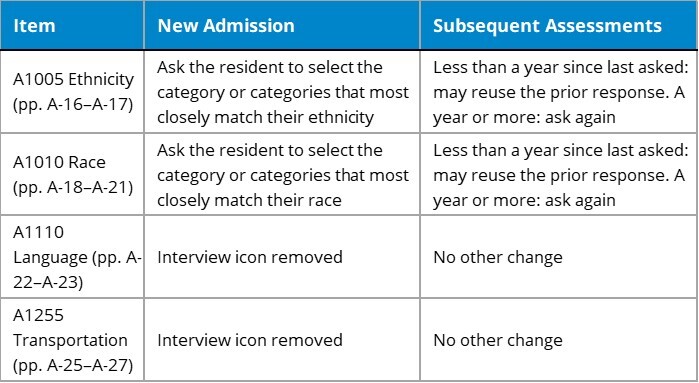
The interview icon has been removed from four Section A items: A1005 Ethnicity, A1010 Race, A1110 Language and A1255 Transportation. The resident is still the source for race and ethnicity, but the steps for assessment are now split between new admissions and later assessments.

What it means: you no longer need to re-ask race and ethnicity at every assessment. The simplest way to stay current is to ask these questions with each comprehensive assessment, such as an Annual or Significant Change assessment, so residents are asked at least once a year.
C0100 (page C-2). CMS removed the suggestion to conduct the resident interview “preferably the day before or the day of the ARD.” The rule is now simply: if the resident interview was not conducted within the look-back period, code C0100 as 1, Yes, and enter a dash (–) in the resident interview items.
C0200–C0500 (page C-6). If more than one BIMS is conducted during the look-back period, code the MDS with the BIMS conducted closest to the ARD.
D0150 (page D-7). The same rule now applies to mood: if more than one PHQ-2 to 9© interview is conducted during the look-back period, use the one closest to the ARD.
What it means: interviews can happen any time in the look-back window, but when disciplines each run their own BIMS or PHQ, there is now one tie-breaker: proximity to the ARD.
Most of the Section I edits (I0100–I8000, pages I-9 through I-13) are punctuation, but the coding instructions are worth a re-read. Active diagnoses are still coded when there is a documented diagnosis in the last 60 days that relates directly to the resident’s status, treatments, monitoring or risk of death during the 7-day look-back. As a reminder, a diagnosis must be documented by a physician or physician extender and be active during the look-back period.
The exception is I2300, UTI, which does not use the active diagnosis 7-day look-back. The page reference for its specific instructions is updated to pages I-14–I-15.
What it means: no change in practice, but update any internal tip sheets that cite the old page numbers.
Pain management (J0100A–B, pages J-2–J-3). J0100A now reads “Received scheduled pain medication regimen?” instead of “Been on a scheduled pain medication regimen.” J0100B now reads “Received PRN pain medications OR was offered and declined?” That means an offered-and-declined PRN is now recognized.
Shortness of breath (J1100, page J-25). The steps for assessment gain a sixth step: if the resident reports avoiding an activity (for example, lying flat) because of shortness of breath, do not require the resident to perform that activity.
The existing steps remain: interview the resident (including those with mild to moderate dementia), ask about activity-related symptoms, review the record and interview staff on all shifts and family, and observe for signs such as pursed-lip breathing, accessory muscle use or interrupted speech.
Falls (J1800, page J-35). The steps now spell out the review window:
First assessment since admission (A0310E = 1 and A1700 = 1): review from the admission date to the ARD.
First assessment since reentry (A0310E = 1 and A1700 = 2): review from the reentry date (A1600) to the ARD.
Review every source for falls since the last assessment, whether in the community, in an acute hospital or in the nursing home, including records from any health care setting.
Review incident reports, fall logs and physician, nursing, therapy and nursing assistant notes.
Ask the resident and family. Falls they report are captured whether or not they appear in the medical record.
What it means: J0100B may capture more residents than before, and fall look-back for reentries starts at A1600, not the original admission.
Section M has the most consequential change in this update.
Reopened ulcers are no longer “present on admission” (M0300). The old rule said a pressure ulcer/injury documented on admission that closed and then reopened at the same stage was still coded as present on admission. That sentence is gone.
Now, if an ulcer/injury was documented on admission, subsequently healed and then opens again, it should not be coded as present on admission. Expect this to affect facility-acquired pressure ulcer counts.
Advanced wound care dressings and skin substitutes. Three items now say the same thing in different places:
Adhesive bandages don’t count. M1200E and M1200F now state that topical dressings do not include adhesive bandages such as BAND-AID® bandages or wound closure strips.
Other open lesions (M1040C and M1040D, pages M-33–M-34). Examples were moved out of the item labels and into new coding tips:
M1040D, Open lesion(s) other than ulcers, rashes, cuts, covers lesions that develop as part of a disease or condition and are not coded elsewhere on the MDS, such as wounds, bullous pemphigoid lesions, boils, cysts and vesicles.
O0110 single room isolation is still coded only when the resident requires transmission-based precautions and is alone in a separate room because of an active infection with a highly transmissible or epidemiologically significant pathogen. CMS removed the phrase describing those pathogens as ones “acquired by physical contact or airborne or droplet” transmission.
All four conditions must still be met:
The resident has an active infection (symptomatic and/or a positive test and in the contagious stage) with a highly transmissible or epidemiologically significant pathogen.
Precautions go beyond standard precautions: contact, droplet and/or airborne precautions are in effect.
The resident is alone in the room because of the active infection and cannot be cohorted, even with a roommate who has the same infection.
The resident must remain in the room, with all services (rehab, activities, dining) brought to them.
Do not code O0110 for a history of infection without active symptoms (for example, s/p MRSA or s/p C. diff) or when only standard precautions such as hand hygiene, gloves, masks, eye protection or gowns are in use. Urinary tract infections, encapsulated pneumonia and wound infections are given as examples where the criterion would not apply.
The therapy changes center on respiratory therapy and on what counts as skilled.
Respiratory therapy minutes (O0390, page O-23). Only time the respiratory therapist or respiratory nurse spends with the resident counts toward the 15 minutes per day. That includes evaluation and assessment, treatment administration and monitoring, and equipment setup and removal. Excluded:
Therapy modalities (O0390, page O-32). Maintenance-level/prophylactic incentive spirometry joins the hot pack as an example of a modality that is often not skilled. Minutes can be recorded only when the resident’s condition requires the therapist’s skills, knowledge and judgment. Document the use and rationale for every modality, skilled or not, in the care plan.
New examples (page O-33). Resident S received 10, 7 and 13 minutes of skilled respiratory therapy on three days. O0390D is not checked, because no single day reached 15 minutes. Resident P, with stable COPD, used an incentive spirometer with nursing help for 15 minutes daily. It is also not checked, because maintenance treatment in a stable resident does not need a respiratory therapist’s or nurse’s skill.
O0400D Respiratory therapy days (page O-34). Complete only if O0390D is checked. Enter the number of days in the last 7 on which the resident received 15 or more minutes of skilled respiratory therapy. In the manual’s example, Resident F received 10 minutes a day Sunday–Wednesday and 15 minutes a day Thursday–Saturday, so O0400D2 is coded 3. CMS removed the old rationale that divided total minutes by 7 days: do not average minutes across the week.
What not to code (page O-25). Do not code services in O0390, O0400 or O0425 when therapy is family-requested and not medically necessary, when aides perform the service under a licensed person’s supervision, or when a therapist (licensed or not) provides a service that is not listed in the manual or on the MDS.
Part A therapies (O0425, pages O-36–O-37 and O-40). References to respiratory, psychological and recreational therapy were removed. As of October 1, 2026, the section describes rehabilitation only as speech-language pathology, occupational therapy and physical therapy.
Section P, Restraints (pages P-5 and P-11): the CFR and survey citations were clarified.
Section Z: Z0200C was removed from page Z-2.
Appendix C: the nutrition resource now points to the Academy of Nutrition and Dietetics position paper, Individualized Nutrition Approaches for Older Adults: Long-Term Care, Post-Acute Care, and Other Settings, available from the Academy’s positions page.
Always confirm details against the most current version of the CMS MDS 3.0 RAI Manual.
These changes touch assessment timing, wound coding, isolation and therapy minutes, all areas that affect quality measures, reimbursement and survey readiness. Richter’s MDS specialists can walk your team through the updates, audit recent assessments against the new rules and update your internal tools so errors don’t show up in your data.
Request a consultation or email info@richterhc.com to talk with our team about your transition plan.
Frequently Asked Questions About the October 2026 RAI Manual Changes
When do the changes take effect?
October 1, 2026, with version 1.20.11 of the MDS 3.0 RAI Manual. Assessments with an ARD on or after that date follow the updated manual.
Do we still have to ask residents about race and ethnicity at every assessment?
No. If the resident was asked less than a year ago, you may reuse their previous answer. After a year or more, ask again.
What if more than one BIMS or PHQ interview happens during the look-back period?
Code the MDS using the interview done closest to the ARD.
A pressure ulcer was present on admission, healed, then reopened. Is it still "present on admission"?
No. Under the updated M0300 guidance, a healed ulcer that reopens is not coded as present on admission.
Is an advanced wound dressing or skin substitute on a pressure ulcer a surgical wound?
No. It isn't a surgical procedure, a graft or a flap. Code the care in M1200E, Pressure ulcer/injury care, not as surgical wound care.
Can we average respiratory therapy minutes across the week?
No. A day only counts toward O0400D if the resident received 15 or more minutes of skilled respiratory therapy on that day.
Does nurse-assisted incentive spirometry count as respiratory therapy?
Usually not. For a stable resident, maintenance or preventive spirometry doesn't need a respiratory therapist's or respiratory nurse's skill. It counts only when the resident's condition calls for that skill.
Can our state change how we code MDS items?
No. States can require extra assessments, but they can't change CMS coding instructions for items outside Section S.
Jodie Abbinante
Business Development Representative
Schedule your complimentary 30 minute discovery call so our team can learn about your goals and how we might be able to help.
Subscribe to our newsletter to receive the latest articles and updates aimed at helping you enhance operational, clinical and financial outcomes.