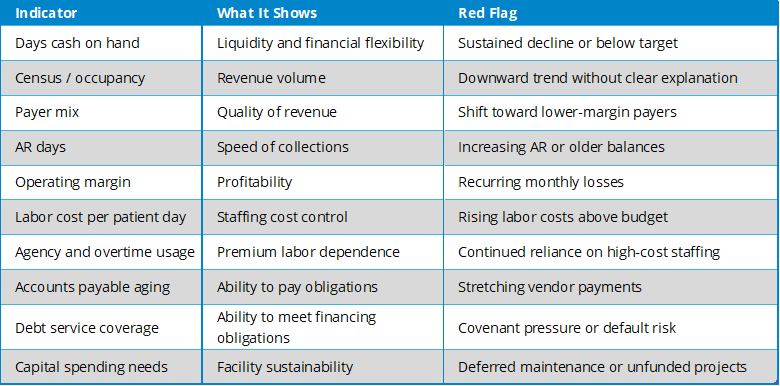
Board members and owners do not need to be accountants to recognize when a post-acute or senior care organization is drifting into financial trouble. They do, however, need to know which numbers matter, what those numbers are really saying and when to start asking harder questions.
In many skilled nursing, assisted living, memory care, rehabilitation and continuing care organizations, financial distress rarely appears all at once. It usually shows up gradually: a few more open beds than usual, a slower accounts receivable cycle, more reliance on agency labor, delayed vendor payments, tighter cash balances or monthly financial statements that arrive later and later.
Individually, each issue may seem manageable. Together, they can signal that the organization’s financial foundation is weakening.
For board members, the goal is not to micromanage operations or second-guess management. The goal is to recognize warning signs early enough to ask the right questions, support corrective action and protect the long-term health of the organization.
Post-acute and senior care providers operate in a uniquely difficult financial environment. Revenue is often tied to census, payer mix, reimbursement rates, length of stay, managed care contracts and regulatory requirements. Expenses are heavily driven by labor, insurance, supplies, food, utilities, debt service and compliance costs.
That combination creates a narrow margin for error.
A facility can appear stable on the surface while cash is quietly tightening underneath. Occupancy may look acceptable, but if the payer mix has shifted toward lower-margin sources, profitability may be declining. Revenue may be growing, but if receivables are aging or collections are slowing, cash may still be under pressure. Staffing levels may be adequate, but if the organization is relying heavily on premium-pay agency labor, operating performance may be deteriorating.
Board members should therefore look beyond the income statement. A monthly profit or loss number matters, but it is only one piece of the picture. The better question is: What is changing, and what does that change suggest about future financial performance?
One of the most important indicators for any senior care organization is days cash on hand. In plain language, this measures how many days the organization could continue operating using available cash if no new money came in.
A declining cash position does not always mean a crisis is imminent, but it should never be ignored. Cash is what allows the organization to make payroll, pay vendors, manage census fluctuations, invest in building needs and respond to emergencies.
Board members should pay attention when cash balances are declining month after month, when the organization is using reserves to fund routine operations or when leadership begins delaying nonessential payments to preserve liquidity.
Questions to ask:
“What is driving the decline in cash?”
“Is this a timing issue, or are operations consistently using more cash than they generate?”
“How many days of cash do we consider our minimum acceptable threshold?”
“What is the plan to rebuild liquidity?”
A useful action trigger is a sustained decline over several reporting periods or any drop below the organization’s board-approved liquidity target.
services.
PointClickCare® Red Flag #2: Slipping Census or Occupancy
In post-acute and senior care, census is one of the first places financial stress often appears. Empty beds create immediate revenue pressure, while many expenses remain fixed. The building still needs staff, utilities, insurance, dietary services, maintenance and administrative support.
A small census decline may be manageable. A sustained trend is different.
Board members should watch not only total occupancy, but also where the changes are occurring. Is short-term rehab volume declining? Are hospital referrals down? Is assisted living move-in activity slowing? Are discharges increasing? Is the facility losing residents to competitors, hospitals, home health or alternative care settings?
Questions to ask:
“Is the census decline temporary, seasonal, or structural?”
“Which referral sources have changed?”
“Are declines concentrated in skilled nursing, short-term rehab, assisted living, memory care, or long-term care?”
“How does our current occupancy compare with budget, prior year, and local competitors?”
“What is our conversion rate from inquiry to admission?”
“Are hospital referrals, managed care referrals, or physician referrals declining?”
“Have referring hospitals or discharge planners raised concerns about quality, responsiveness, readmissions, staffing, or care outcomes?”
“How do our quality ratings, survey results, rehospitalization rates, and discharge outcomes compare with competitors?”
“Are online reviews, family complaints, grievance trends, or resident satisfaction scores affecting our reputation in the market?”
“What is management doing to strengthen admissions, marketing, referral relationships, and clinical performance?”
The red flag is not one bad census month. The red flag is a pattern that leadership cannot clearly explain or reverse.
reverse.
A facility can maintain occupancy and still experience financial deterioration if the payer mix shifts in the wrong direction.
For example, an organization may have the same number of occupied beds as last quarter, but fewer higher-reimbursing short-term rehab or Medicare residents and more lower-margin Medicaid or long-term care residents. In that case, total census may look stable while revenue per patient day declines.
Board members should regularly review payer mix, average revenue per patient day and margin by service line where available.
Questions to ask:
“Are we filling beds at the right economic value?”
“How has our payer mix changed compared with budget and prior year?”
“Is our skilled payer mix declining?”
“If skilled referrals are declining, do we know why?”
“Are managed care rates covering the cost of care?”
“Are we accepting admissions that create operating losses?”
“Are hospitals or managed care plans choosing competitors for higher-acuity or post-acute referrals?”
“Have quality ratings, survey findings, rehospitalization rates, discharge outcomes, or staffing concerns affected our ability to attract skilled referrals?”
“Do we have the clinical capabilities, staffing levels, specialty programs, and outcomes data needed to compete for higher-reimbursing admissions?”
“Are we tracking referral denials, lost referrals, and reasons why hospitals or payers select another provider?”
“Do we understand profitability by unit, payer, and level of care?”
A full building is not necessarily a financially healthy building. The quality of the revenue matters.
Accounts receivable, often called AR, represents money owed to the organization for services already provided. Some AR is normal. But when AR grows too quickly, it may mean the organization is having trouble collecting what it has earned.
This is especially important in healthcare, where billing complexity, documentation requirements, payer denials, managed care delays, Medicaid eligibility issues and private-pay collection problems can all create cash pressure.
Board members should watch AR days, aging by payer, denial trends, write-offs and the percentage of receivables over 90 or 120 days old.
Questions to ask:
“Why are receivables increasing?”
“Which payers or categories are causing the delay?”
“How much AR is older than 90 days?”
“Are billing and collections adequately staffed?”
“Are we seeing more denials, documentation issues or authorization problems?”
The action trigger is simple: if receivables are rising while cash is falling, the board should ask for a focused explanation and corrective plan.
Every organization can have a difficult month. The concern arises when operating losses become routine and explanations become repetitive.
Common explanations include census timing, delayed rate increases, unusual supply costs, one-time staffing issues or temporary billing delays. Any of those may be valid. But board members should be cautious when “temporary” explanations continue for several months.
A recurring operating loss means the organization’s revenue is not covering its expenses. That gap must be addressed through revenue improvement, expense control, service line changes, rate adjustments, debt restructuring, fundraising, strategic partnerships or other corrective actions.
Questions to ask:
“What would our results look like without one-time adjustments?”
“Are losses concentrated in one program, building, payer type or department?”
“What specific actions are being taken to return to break-even or better?”
“When should the board expect measurable improvement?”
“What happens if the current trend continues for six more months?”
A board should not accept vague optimism in place of a measurable turnaround plan.
Delayed vendor payments are often one of the clearest signs of cash strain.
Management may not always describe the issue as a liquidity problem. It may be framed as “timing,” “cash management” or “prioritizing payments.” But if the organization is stretching payables to preserve cash, the board should understand why.
Delayed payments can damage vendor relationships, reduce supply reliability, increase costs and signal broader financial weakness. In a care environment, interruptions in pharmacy, food service, medical supplies, therapy, maintenance or staffing vendors can also create operational risk.
Questions to ask:
“Are we paying vendors within normal terms?”
“Have any vendors placed us on hold, changed terms or required deposits?”
“Are we delaying payments because of cash constraints?”
“What is the current accounts payable aging?”
“Do we have a plan to bring payables current?”
The board should be especially alert when both accounts receivable and accounts payable are increasing. That may mean the organization is not collecting quickly enough to meet its obligations.
Many senior care organizations carry debt, lease obligations, mortgage payments or other financing commitments. Those obligations may include financial covenants, such as minimum liquidity, debt service coverage or operating performance requirements.
If performance weakens, covenant compliance can become a serious concern. Even before a technical default occurs, lenders may begin asking more questions, restricting flexibility or requiring additional reporting.
Capital needs are another major issue. A facility may be able to defer roof repairs, HVAC replacements, technology upgrades or renovations for a while, but not forever. Deferred capital spending can eventually affect census, resident satisfaction, regulatory compliance and market competitiveness.
Questions to ask:
“Are we in compliance with all lender and lease requirements?”
“Are any covenants at risk?”
“What capital projects have been deferred?”
“What is the estimated cost of our most urgent building needs?”
“Do we have a realistic capital plan?”
A facility that is meeting today’s payroll but cannot fund tomorrow’s building needs may still be financially vulnerable.
The quality and timeliness of financial reporting is itself a financial indicator.
Board members should receive reports that are timely, accurate and understandable. They should include comparisons to budget, prior year and key operating metrics. They should explain major variances and identify corrective actions.
When financial statements are consistently late, when numbers change significantly after initial reporting or when management cannot explain variances clearly, the board should pay attention.
Questions to ask:
“Why are reports delayed?”
“Are reconciliations current?”
“Do we have enough finance staff and systems support?”
“Are budget variances clearly explained?”
“Can management identify the operational drivers behind the numbers?”
Strong reporting does not solve financial problems by itself, but weak reporting makes problems harder to see until they are more severe.
Perhaps the most important red flag is not a number at all. It is the absence of a clear plan.
When performance is under pressure, leadership should be able to explain what is happening, why it is happening, what actions are underway, who is accountable and when results should improve.
A good corrective plan does not need to be complicated. It should identify the issue, the financial impact, the action steps, the timeline and the metric the board will use to monitor progress.
For example:
“Agency nursing costs are running $125,000 per month over budget. Management is targeting a 30% reduction over the next 90 days through recruitment incentives, schedule redesign and preferred agency rate negotiations. Progress will be reported monthly.”
That is very different from saying, “We expect staffing costs to improve soon.”
Board members should insist on specifics.
Board members do not need to review every accounting detail. But they should regularly see a focused dashboard that includes the organization’s most important financial and operating indicators.
At a minimum, that dashboard may include:

The dashboard should not just report numbers. It should highlight trends, explain variances and identify action triggers.
Financial oversight is one of the board’s most important responsibilities. That does not mean board members need to become accountants, reimbursement specialists or operators. It means they need to be curious, disciplined and willing to ask direct questions when the numbers begin to change.
The best boards do not wait until a crisis is obvious. They recognize early signals and respond while there is still time to make thoughtful decisions.
That starts with a few habits:
Ask for trends, not just monthly snapshots.
Compare actual results to budget and prior year.
Look at cash, not just profit.
Connect financial results to operational drivers.
Request written action plans when performance misses expectations.
Follow up until improvement is visible.
In senior care, financial strength is not separate from mission. A financially healthy organization is better positioned to invest in staff, maintain its buildings, serve residents, comply with regulations and respond to changing market conditions.
The sooner board members recognize financial red flags, the more options leadership has. And in a sector where margins are often tight and obligations are high, early recognition can make the difference between a manageable course correction and a financial crisis.
To learn more about Richter’s accounting, outsourced revenue cycle management or reimbursement consulting services, contact us at info@richterhc.com or click here to schedule a conversation.
Richter partners exclusively with long-term post-acute care providers to deliver tailored, high-impact solutions across clinical, financial and operational domains. Our team of more than 90 healthcare consultants brings real world industry expertise to help leadership teams improve compliance, strengthen financial performance, optimize revenue cycle management, streamline EHR and PointClickCare systems and manage Medicaid eligibility with confidence. Acting as a trusted extension of your organization, we provide personalized guidance, expert-led enablement and end-to-end support that reduces complexity while driving measurable growth. With a focus on sustainable outcomes that strengthen clinical quality, financial stability and operational efficiency, while reducing risk and advancing resident care excellence, Richter empowers skilled nursing communities, senior living providers, home health and hospice organizations to achieve long-term success in today’s complex healthcare landscape.
Subscribe to our newsletter to receive the latest articles and updates aimed at helping you enhance operational, clinical and financial outcomes.